Recommendations
The Recommendations dashboard acts as a personal accountant, offering actionable ways for you to save on infrastructure costs.
These recommendations are based on the AWS Cost and Usage Report (CUR), which has a data latency of up to 2 days, and do not take into account real-time metrics. Make sure to validate and analyze your actual resource utilization before applying any recommendations.
Cost Optimization Best Practices
- Provides best practices for cost optimization tailored to each customer's unique usage patterns.
- Lens suggests practical steps to reduce costs without compromising performance.
Example Recommendations
Move to Lower Cost Instances
- Lens provides service-wise, resource-level data highlighting where customers can switch to lower-cost instances.
- These recommendations ensure cost savings while maintaining or even improving performance.
- Additional details are provided when clicking on "More Info", explaining how the savings are calculated and the criteria used for this recommendation.
Remove Idle Network Resources
- Lens identifies idle resources, such as Load Balancers or NAT Gateways, recommending their removal to avoid unnecessary costs.
- Detailed recommendations include suggested actions, and users can see how much they can save by taking action.
Additional Recommendations
Beyond the above examples, Lens offers further tailored recommendations designed to help customers continually optimize and control their AWS spending.
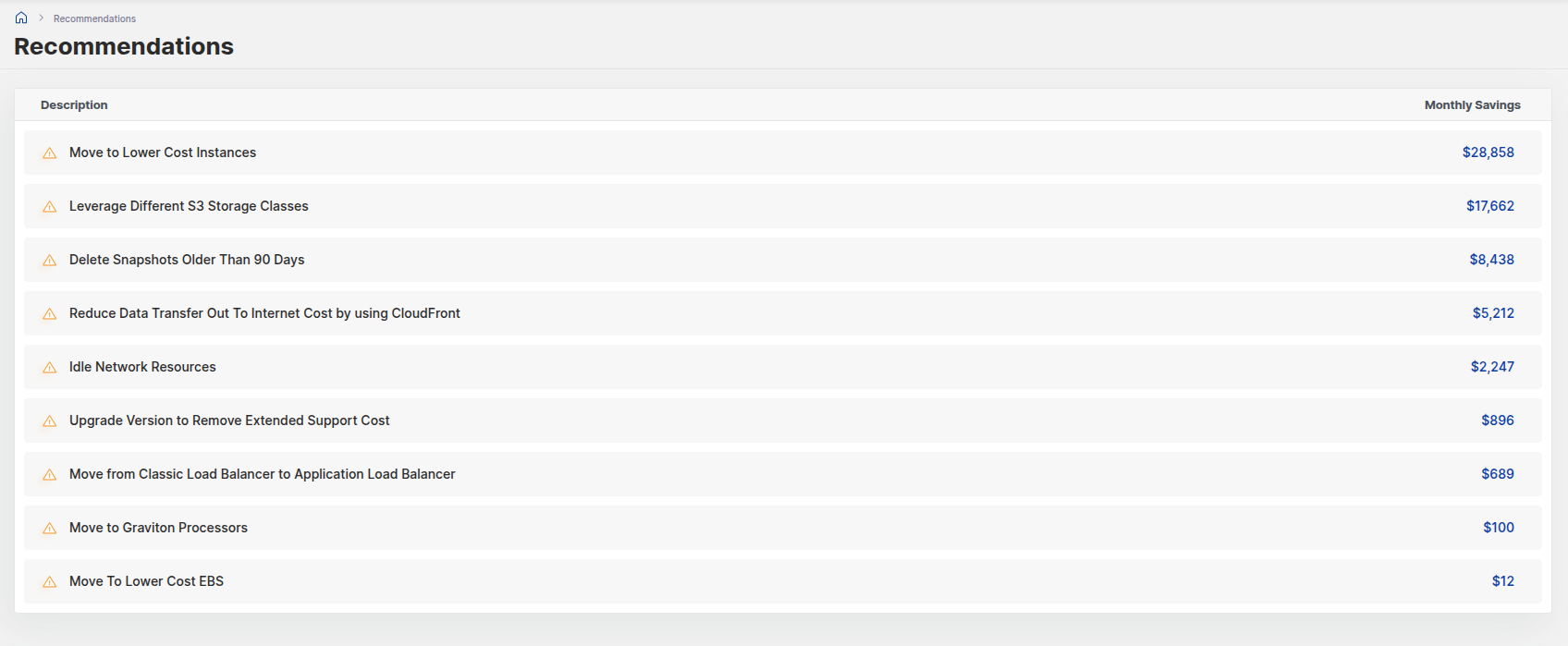
You can click on any recommendation to open a detailed view that explains the logic, savings breakdown, and specific actions you can take.
How to get more details
When you click More Info on a specific recommendation, it provides a detailed breakdown, including:
- Savings Estimate: Shows the potential savings after applying the recommendation (e.g., savings per month, year).
- Explanation & Actions: A description of what the recommendation entails, along with suggested actions you can take to apply it effectively.
- Criteria: Explains the criteria used to generate the recommendation. For instance, in EC2 optimizations, it includes whether only On-Demand instances are considered and if the recommended instance type offers higher performance and lower cost.
Example: EC2 Instance Optimization
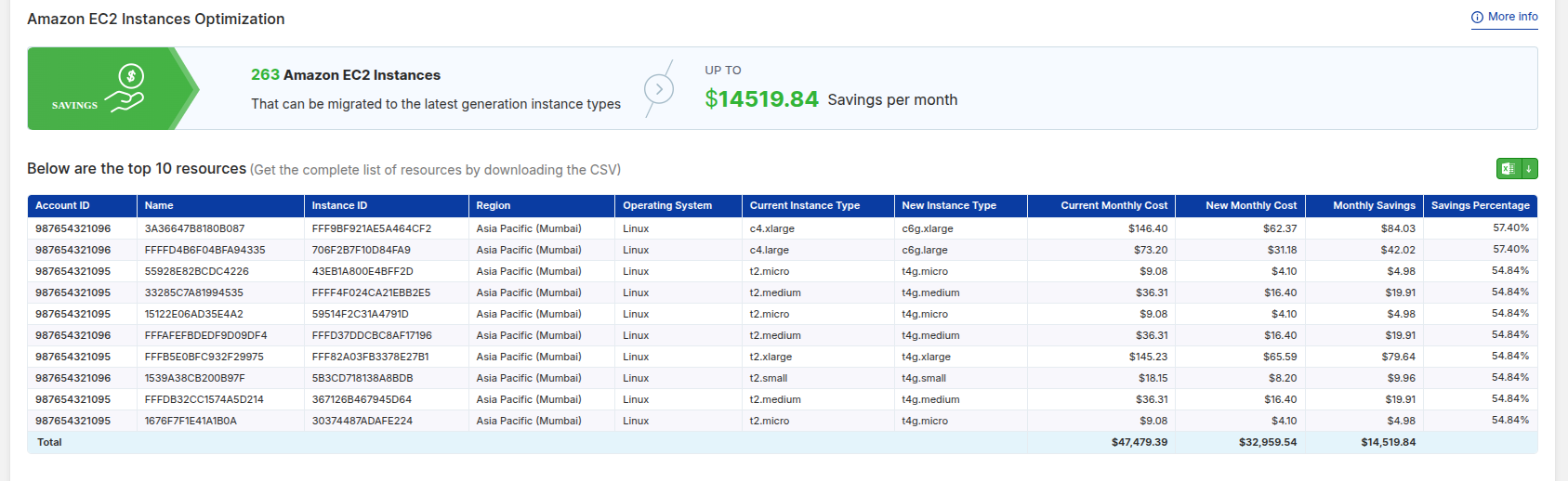
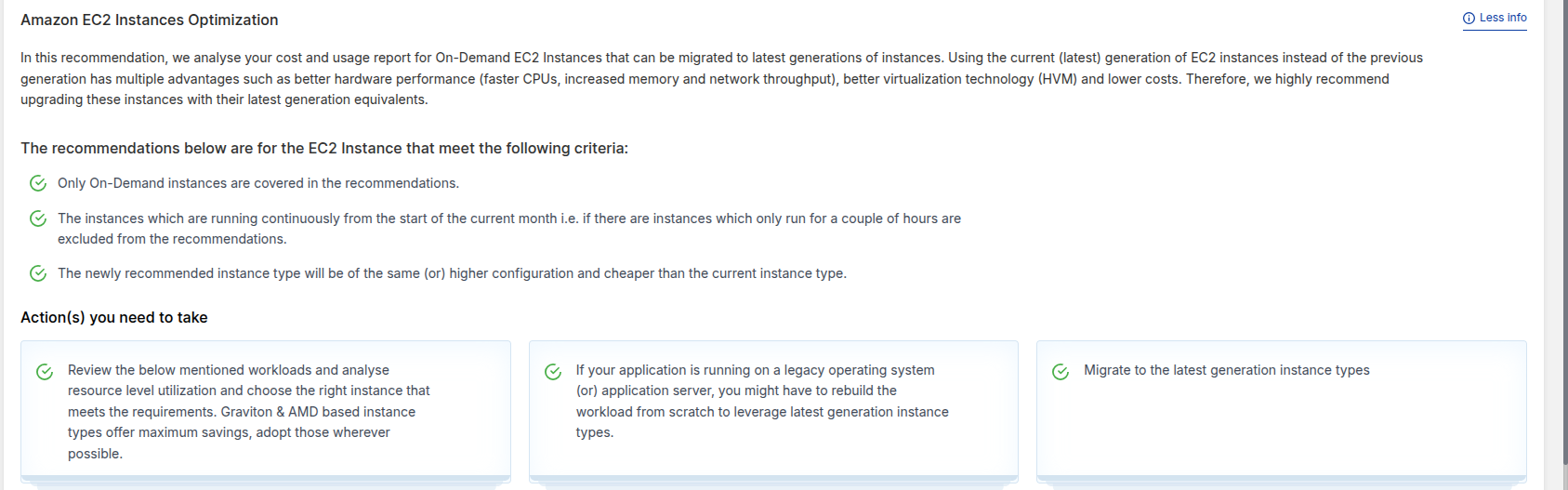
This recommendation analyzes your cost and usage report for On-Demand EC2 instances that can be migrated to the latest generation instance types. Using the current generation of EC2 instances instead of the previous generation has multiple advantages, such as:
- Better hardware performance (faster CPUs)
- Increased memory and network throughput
- Better virtualization technology (HVM)
- Lower costs
The recommendations below are for EC2 instances that meet the following criteria:
- Only On-Demand instances are covered in the recommendations.
- Instances running continuously since the start of the current month are included, while instances used for only a few hours are excluded.
- The recommended instance types are of the same or better configuration than the current instance type but at a lower cost.
Actions to take:
- Review the mentioned workloads, analyze resource level utilization, and choose the right instance type.
- If your application is running on a legacy operating system or application server, you may need to rebuild the workload from scratch to leverage the latest generation instance types.
Example: S3 Storage Optimization
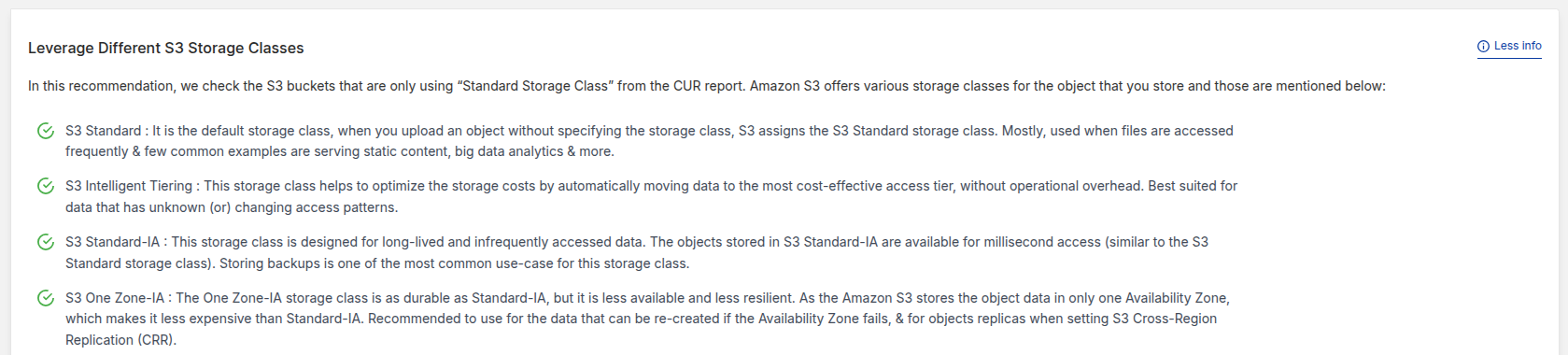
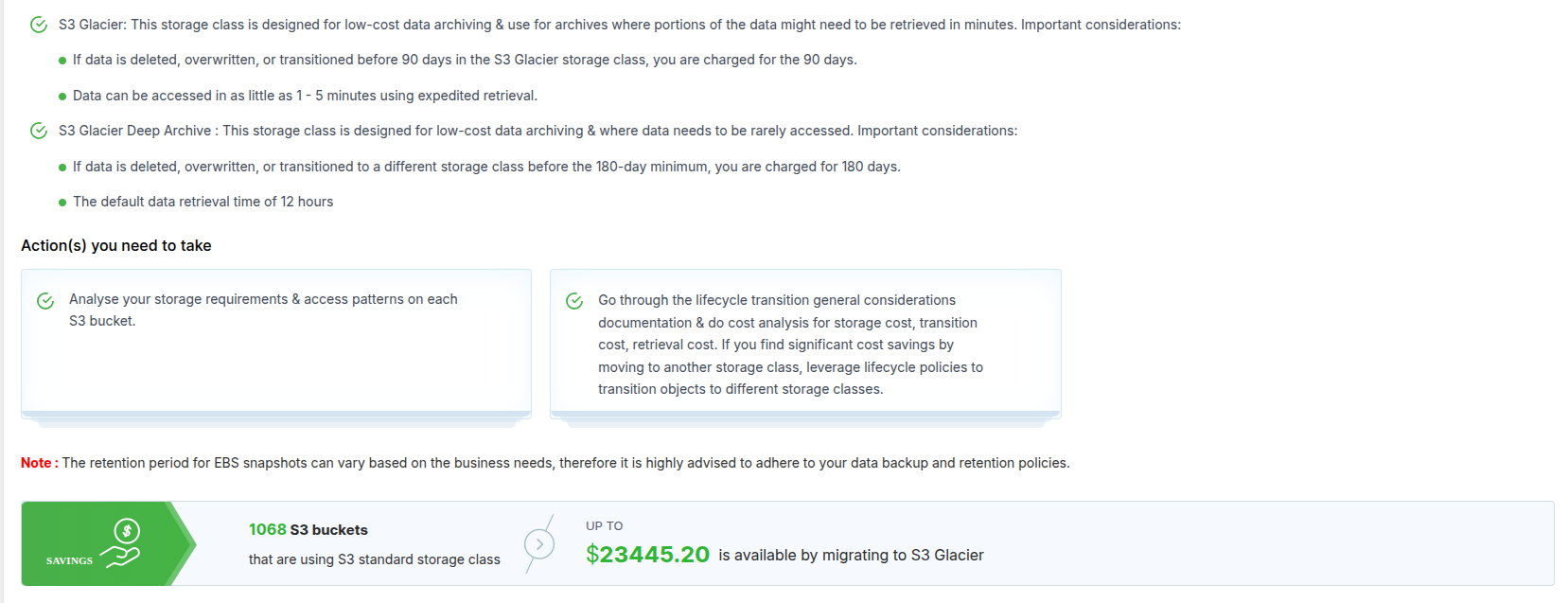
In this recommendation, we analyze the S3 buckets that are only using "Standard Storage Class" from the CUR report. Here are some tips on optimizing S3 storage costs:
- S3 Standard: Used for frequently accessed data.
- S3 Intelligent Tiering: Helps automatically move storage costs to the most cost-effective access tier.
- S3 Glacier: Low-cost storage for archival data.
- S3 Deep Archive: Lowest-cost option for rarely accessed data.
Actions to take:
- Analyze your storage requirements and access patterns on each S3 bucket.
- Review the lifecycle transition considerations and move data to cheaper storage classes like Glacier or Deep Archive if appropriate.